Ask a senior interventional radiologist why the needle goes in below the costal margin and angled up, rather than straight at the lesion four centimetres away, and you will get a fluent, two-minute answer. It will cover the parenchymal cuff that has to tamponade a bleed, the gallbladder wall, where the colon sits in this patient at end-expiration, and what the rib will do when the patient breathes.
Now ask where that answer is written down. It isn't. It was said aloud, once, in the CT room, to whichever trainee was in the room that day.
What gets stored is the conclusion — a target, an entry point, an angle. The three approaches that were considered and rejected, which is where nearly all of the teaching lives, are stored nowhere at all.
Why this is the hard part to teach
Needle handling can be drilled. Phantoms, ultrasound blocks, supervised cases: the motor skill has a training pathway, and programmes run it well.
The decision does not have one. Choosing a target, an entry site and an angle — and defending that choice against the two or three plausible alternatives — is a cognitive skill taught almost entirely by apprenticeship, and apprenticeship has three well-known problems for a programme director:
Exposure is unequal. Two residents finishing the same rotation have not seen the same cases. One was there for the difficult segment V lesion; the other was in clinic that afternoon.
Reasoning is tacit. The trainee sees the approach that was chosen. Unless the operator narrates the rejected ones — while working — the comparison that carries the lesson never happens.
Assessment is subjective. "Good plan" and "not quite" are hard to defend in a competency framework, hard to compare across a cohort, and hard to act on when a trainee is struggling.
None of this is a failure of teaching. It is what happens when the curriculum depends on who was in the room.
What Learn mode is
Learn mode turns Percisio Intervention Planner into a teaching instrument. It has two halves, in the order they are meant to be used: Watch, then Try.
Watch — the reasoning, replayed
A walkthrough is a senior operator's planning rationale, recorded step by step over a real patient study, and replayed on demand. Each step moves the views, shows the relevant anatomy, draws the candidate paths under discussion, and carries the operator's own words about them.
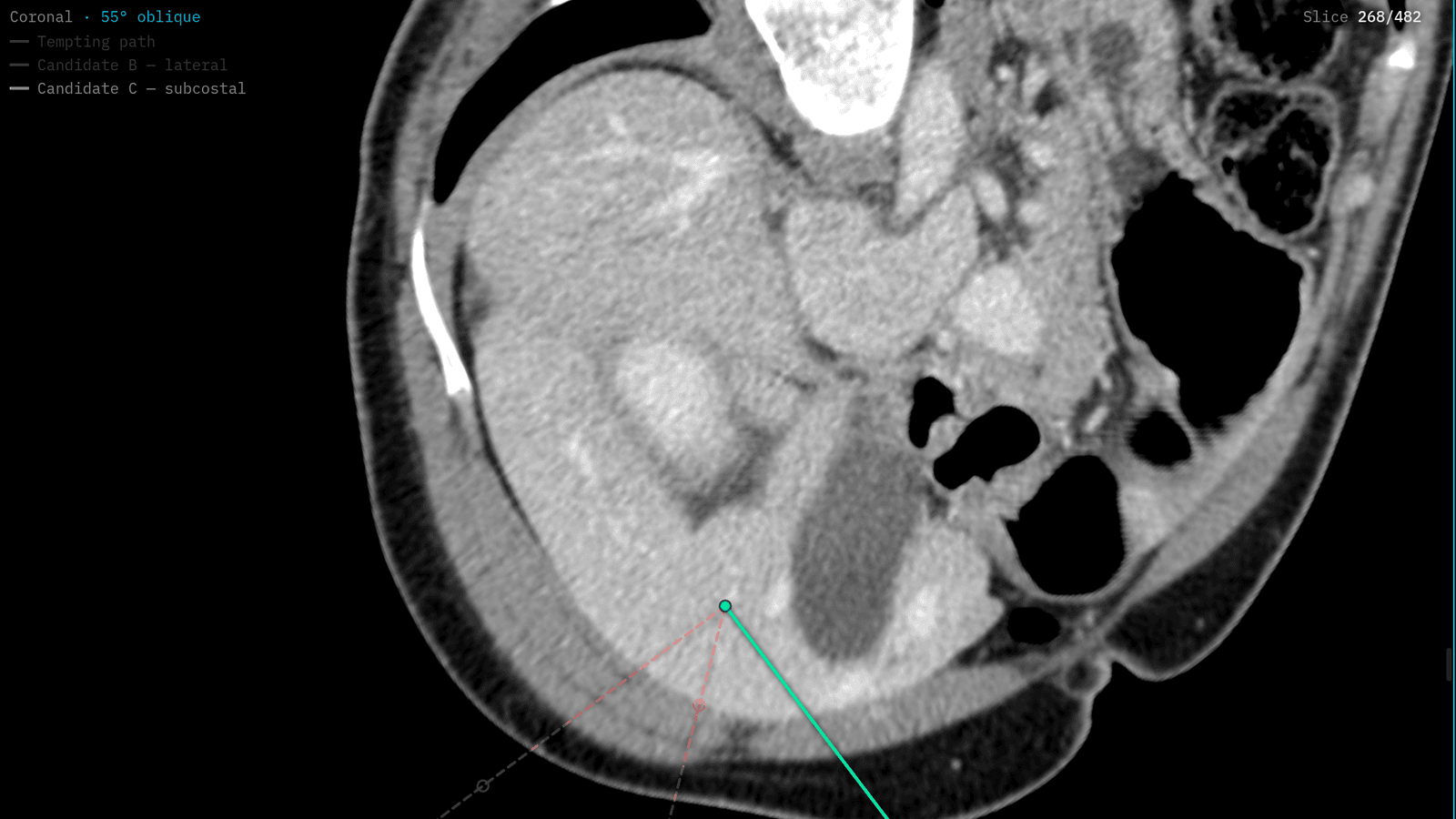
The selected subcostal approach, with the two rejected candidates still on screen. The narration is the operator's own: 3 cm of normal parenchyma before the lesion, 9 mm clearance from the gallbladder wall, colon well clear — and the longer path is the price of a safe one.
The rejected candidates are the point. A trainee who only ever sees the chosen approach learns a fact; a trainee who watches the short, tempting path get rejected for having almost no parenchymal cuff learns a rule they can apply to the next patient.
Because the walkthrough runs on the real study, the images are the images. Each view is re-cut so the path under discussion genuinely lies in the slice — what the trainee reads off the screen is the tissue the needle would actually cross, not a line projected over anatomy it never touches. On a teaching image, that distinction is the whole game.
Try — the same case, in their hands
The trainee then plans the case themselves, with the same tools the department uses clinically, and the plan is marked against the validated path.
Marked, with reasons. This attempt is 11.5° off the expert's axis and 23.5 mm from its entry point — but it clips the gallbladder, and that is where it loses its points.
Four criteria, weighted the way an attending weights them in conversation: structures avoided, approach angle, skin entry site, path length. Aiming at the wrong structure scores zero rather than losing a few points, because that is a different exercise, not a near miss.
Every line says what it measured and why it cost what it cost. A trainee can adjust the path and be re-marked immediately — deliberate practice, on a case that never has to be scheduled, with no patient and no radiation.
How programmes use it
Before the rotation. Assign two or three walkthroughs as preparation. The trainee arrives having already seen how your consultants approach a subcostal liver lesion — so the time in the room is spent on this patient, not on first principles.
In the skills session. Run a walkthrough on the big screen and stop on the rejected candidates. "Why not this one?" is a better seminar than any slide deck, and everyone is looking at the same anatomy.
As deliberate practice. A trainee plans, is marked, sees the expert path beside their own, replans. The loop takes minutes and can be repeated across a case library until the reasoning is automatic.
As evidence. Every trainee in a cohort can attempt the same case against the same reference, and the breakdown gives a supervisor somewhere concrete to begin: not "your plans need work", but "you crossed the gallbladder on this one — look again at how the selected path clears it."
As remediation. When a trainee is struggling with approach selection specifically, this isolates that skill from everything else a procedure demands.
Start with the library, then make it yours
There is a library to teach from on day one. Learn mode ships with worked cases authored with expert operators — the segment V subcostal approach in this article is one of them — each with its candidate approaches, its narration and a validated reference path to be marked against. A programme can run its first session without preparing anything, and the library grows.
Then you add your own. Walkthroughs are authored in the planner itself, from your own studies: plan the validated path, save it as the case reference, then record the steps and the narration that goes with them. Your patient mix, your protocols, your consultants' voices — sitting alongside the shipped cases rather than replacing them.
And the marking scheme is explicit. The tolerances behind the score — what counts as full marks for approach angle, how far off the entry point stops earning points — are stated in one place and meant to be set by your interventional radiologists. A score is only teaching material if the department stands behind the number.
What it does not replace
It does not teach needle handling; phantoms and supervised cases still do that. It does not assess sterile technique, patient consent, or how a trainee behaves when a case goes badly. It trains the decision — the part that currently depends on being in the right room on the right afternoon — and it makes that part assignable, repeatable and reviewable.
See it running
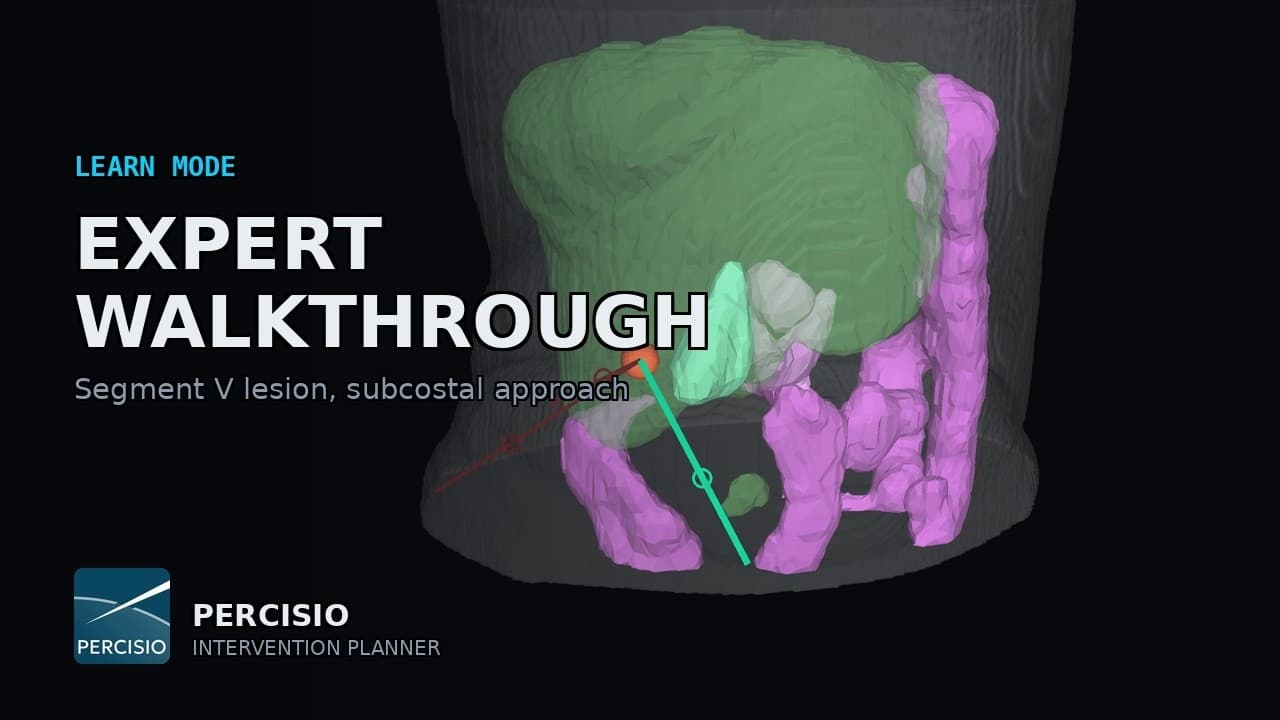
Seventy-nine seconds of a complete walkthrough: three candidate approaches proposed, two rejected with reasons, and the selected one confirmed on a view cut along the trajectory itself. If your network blocks embedded video, it is also on YouTube.
If you are building or revising a percutaneous training curriculum and want to see Learn mode against your own studies, book a walkthrough with us.
Demonstration only — not a medical device and not for clinical use. The planning narration shown is an authored teaching script, not a record of an actual procedure and not the opinion of any named clinician; clearances, distances and angles describe this dataset only. CT and segmentations: 3D-IRCADb-01, IRCAD France.
About Percisio
Percisio is a medical technology company developing AR-powered guidance for image-guided procedures. The platform enhances precision, reduces radiation exposure, and supports clinicians across interventional radiology and related specialties.
Get in touch